and the knowledge to use it for your greater good. Phil Chave
|
|
|
Distant Healer - Give yourself the gift of healing energy, the wisdom to accept it, and the knowledge to use it for your greater good. Phil Chave |
|
Home About Phil Request Healing Contact Treatments Articles Products Appointments Gift Solutions  Phil Chave creator of Distant Healer |
Dealing With Anger in RelationshipsAnger costing you? Talk in confidence about your anger issues in a therapeutic setting. Learn to manage and recognize your own anger issues or problemsAnger is a powerful, perfectly normal emotion that everyone feels at one time or another. Anger experts say that anger develops more often in the family in marriage and with children than in any other human relationship. A second common setting for anger episodes is at work, with colleagues and supervisors. As a consequence, more people are injured by the violent acts of someone they live or work with than by strangers. Anger is probably the most poorly handled emotion in our society. It is the detonator of road rage on the roads or freeway, flare-ups in the sports arena, violence at school and domestic abuse in homes. Anger is the source of many legal problems and many psychophysical diseases such as headaches, high blood pressure and chronic pain. Science has just recently begun to recognize the contribution anger makes to these and other diseases. When coupled with workplace and family stress, unresolved anger can cause emotional, physical and spiritual health to suffer. This can lead the angry one to lash out at the nearest person. Managing anger successfully can make the difference between misery or happiness. This MontGuide has been written to help you understand anger and how to manage it better. It also provides some ideas for dealing with others' anger. What is Anger?According to expert Charles Spielberger, anger is "an emotional state that varies in intensity from mild annoyance to intense fury and rage." Many things can provoke angry feelings. People (such as a boss reminding you of a deadline for the fourth time this week) or daily events (such as getting dawdling kids off to school) might initiate anger. Worrying about personal problems or recalling events that were tragic or made you mad can also set off angry feelings.Anger is expressed in three ways:
Dealing With Our Own AngerAs much as we like horses, few of us would be willing to ride one without a bridle. Around the world there are various categories of bridles. Within these categories there are literally hundreds of different kinds of bridles depending on what we want to do with the animal. But the major purpose is the same: To get the horse to do what we want it to do.Using a bridle doesn't deny that the horse exists, nor does it mean that the horse is a bad animal. Quite the contrary. Bridles allow us to manage and guide the horse to accomplish our purposes. Anger is like an unbridled horse. Unless we govern it, we are at its mercy. The consequences of unbridled anger aren't the ones we really want. Here are some suggestions for putting a bridle on anger. Understand that anger is a choice. Since anger can be controlled, it follows that anger is a choice. Anger is a learned response to a trigger in our environment. While we may have a tendency to become angry, it's not wise or correct to give in and simply say "That's just the way I am, and there's nothing I can do about it." Ultimately we are in charge of which behaviors we choose in response to the emotions we feel. We often hear people say things like, "She/He made me angry." That statement is inaccurate. No one is ever made to be angry. No one is forced against their will to lose their temper. Remember: Anger is a learned response to a provoking situation. Consider the following diagram. Between every provoking situation and outcome lies the freedom to select the actions we deem appropriate. Habit may make our responses seem almost involuntary, but they aren't. While certain provoking situations may creep up on us so that we respond with a knee-jerk reaction, once the connection between the provoking situation and our response is in our consciousness, we can begin to take more control over our actions. 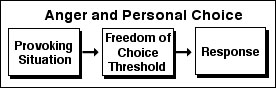 Learn what provokes your anger. While no one can cause us to use anger destructively, the emotion of anger can be provoked in us. So it is wise to learn what your anger triggers are and write them down. Your anger might be provoked when someone ignores the good things you do, puts you down, or shows disrespect for your opinions. As a parent your anger might be aroused toward children when they are messy, don't cooperate or disobey your wishes.
Once you have made a list of your anger triggers, keep the list handy. Spend some time thinking about what you might do instead of reacting angrily the next time someone "pushes your button." For example, if you are angered when your teen won't clean his/her room, give him/her the option of cleaning it once a week and let him/her choose the day and time. Recognize and admit your own anger. Notice what your body does when anger is provoked. Do you feel hot or flushed? Is your heart pounding? Are you breathing more rapidly? Is there change in the tension of the muscles in your neck? Is your head or stomach aching? Also notice the thoughts you have and the actions you do or want to do when you feel anger. Perhaps you are thinking "It's not fair!"or "She's out to get me!" or "He makes me so angry so much of the time!" You may (or you may want to) yell or scream at someone, hit or slap, threaten, order around, or, as a parent, punish a child severely. Notice also signs of hidden anger, such as sarcasm or feelings of frustration or wanting to get even. You may have been taught to deny your angry feelings, or that they don't matter. But feelings do matter. Now is the time for great self-honesty. Realize that anger is a normal emotion. There's no need for you to feel ashamed or guilty about it. Whether at home or at work, give each other the right to feel angry. Feeling angry and acting destructively toward another are two very different things. Relax and calm yourself first. Before the issue that provoked the feeling of anger can be resolved, you must reduce the intensity of the angry feeling by calming yourself. Discover what helps you calm down in anger situations and take action. Calming actions might include calling a friend or relative, listening to music, prayer or meditation, vigorous exercise, writing down feelings in a letter (for yourself), a good night's rest, a warm shower or bath, deep breathing, counting to ten, taking a walk or taking a mental vacation by imagining a peaceful, beautiful place. Strive to understand the other person's point of view. There are many reasons someone may do something that provokes our anger, besides their intentionally wanting to get us angry. Parents would do well to learn possible causes of anger in children at different ages and stages of development and use that knowledge in responding to an anger trigger. For example:
Establish ground rules for expression of anger. This will help you manage anger. For example, when anger and conflict is escalating over an issue, agree that you will call "Time Out" and try talking about it again after you calm yourselves and can listen to one another better. Choose a specified time to talk, such as in 10 minutes or at a later time within 24 hours. Using this kind of ground rule can help you deal with difficulties with less bickering and strife. Express your anger constructively. Express angry feelings calmly and with an attitude of respect, without attacking or blaming the other person. Explain to the other person why you are angry. Use I-statements with a Feeling-When-Because format. For example, "I FEEL angry WHEN the barbeque is left on BECAUSE it wastes gas." Follow up the I-statement with a statement of the change that you believe would solve the problem now and defuse anger in the future. For example:
Make an Anger Bridling Plan. As you read over the ideas above, have you noted any that might help you bridle your anger? Pick one of your anger triggers and come up with a plan for dealing with it. Don't try to deal with all your triggers at once, start with one. Make a chart like the one shown below. My Anger Bridling Plan (Example)
Some of us may have become so accustomed to destructive expressions of anger that we find it difficult to apply the ideas listed above. Reactions to certain anger triggers may have become so ingrained that it seems impossible to change them alone. If this is so, get help from a trusted and trained professional or minister who can help you deal with your anger. Handling Other's AngerDealing with our own anger is one thing. But how do we deal with others' anger? When anger is directed toward us, what steps can we take to defuse a tense situation? Colorado Extension Specialist Robert Fetsch provides helpful hints in his publication, "Dealing With Others' Anger."When confronted with the anger of others, therapists and educators recommend a combination of communication and problem-solving strategies. First take steps to protect yourself from any potential violence (leave, go to a safe house, wait until your partner is sober, etc.). Often a "time-out period" reduces the hostility level. To help reduce chances of aggression, experiment with the following five steps:
Three additional strategies may help handle others' anger: Use the person's name. This will help you get the angry person's attention. Slow down and lower your voice. When someone is very angry, his or her speech will usually be very rapid. Slowing down your rate of speech and lowering your voice may lead the angry person to a more reasonable tone. Sit down. Sitting makes you less intimidating. It also slows an angry person's rapid thoughts and words. Ask the angry person to take a seat beside you as you discuss the problem. Sitting next to a person (versus across from them) is a more supportive position. Spend some time learning about anger, what provokes anger in you and what calms you down. Then choose to express anger constructively so that its expression builds rather than damages relationships. Deal with others' anger toward you in ways that can actually help defuse their anger. Suggested additional reading American Psychological Association. Controlling anger before it controls you. Online article available at: http://www.apa.org/helpcenter/controlling-anger.aspx Further reading on this site: More info on anger: http://www.distanthealer.co.uk/anger_management.htm My final message to you is this: If you have anger issues, and find this is hampering your relationship. Get treatment NOW!. If you live in any of the towns and villages in the list below, you are well within a 2 to 40 minute drive of The Haven Healing Centre, and I'd be delighted to see you. Please call Phil Chave on 01934 740275 to make your appointment or to talk about a treatment plan structured around your needs. Don't wait. Make your appointment today. You'll be glad you did! So said Buddha, Christ, Mohammad and all the spiritual masters who have ever walked among us. |
|
All of These Local Areas Are Within a Short Drive of The Haven Healing Centre, Cheddar, Somerset Abbots Leigh, Ashwick, Avonmouth, Axbridge, Babington, Backwell, Badgworth, Bagley, Banwell, Barrow Gurney, Bason Bridge, Bath, Beckington, Berrow, Biddisham, Bishop Sutton, Bitton, Blackford, Blagdon, Bleadon, Bleadney, Bradford-on-Avon, Brean, Brent Knoll, Bristol, Burnham-on-Sea, Burrington, Butcombe, Cameley, Catcott, Chantry, Chapel Allerton, Cheddar, Chelwood, Chew Magna, Chew Stoke, Chilcompton, Churchill, Clapton, Claverham, Claverton, Cleeve, Clevedon, Clutton, Cocklake, Coleford, Compton Bishop, Compton Dando, Compton Martin, Congresbury, Coxley, Cranmore, Cross, Downhead, Draycott, Dundry, Dunkerton, East Brent, East Harptree, East Huntspill, Easton-in-Gordano, Edithmead, Emborough, Englishcombe, Evercreech, Failand, Farmborough, Farrington Gurney, Felton, Flax Bourton, Freshford, Frome, Glastonbury, Godney, Green Ore, Gurney Slade, Highbridge, Highbury, High Littleton, Hinton Blewett, Hutton, Inglesbatch, Kelston, Kenn, Kewstoke, Keynsham, Kilmersdon, Kingston Seymour, Langford, Litton, Locking, Long Ashton, Lower Weare, Loxton, Lympsham, Mark, Marksbury, Mells, Midsomer Norton, Monkton Combe, Nailsea, Nempnett Thrubwell, Nettlebridge, Newbury, Oldmixon, Paulton, Peasedown, Pensford, Pilton, Portishead, Prestleigh, Priddy, Priston, Pucklechurch, Pudlow, Puxton, Queen Charlton, Radstock, Redhill, Rickford, Ridgehill, Rodney Stoke, Rooks Bridge, Rowberrow, Saltford, Sandford, Shapwick, Shepton Mallet, Shipham, Sidcot, Somerton, Stanton Drew, Star, Staverton, St Georges, Stoke St Michael, Ston Easton, Stone Bridge, Stowey, Street, Temple Cloud, Tickenham, Timsbury, Trowbridge, Ubley, Weare, Wedmore, Wellow, Wells, West Harptree, West Horrington, Weston-Super-Mare, West Pennard, Whatley, Whitchurch, Winford, Winscombe, Wookey, Wraxall, Wrington, Yatton For all enquiries please call Phil on: 01934 740275 |
|
|
Main Menu •
Home Page •
About Phil •
Request Healing •
Contact •
Treatments •
Articles •
|
|
DISCLAIMER: This information is not presented by a medical practitioner and is for educational and informational purposes only. The content is not intended to be a substitute for professional medical advice, diagnosis, or treatment. Always seek the advice of your physician or qualified health provider with any questions you may have regarding a medical condition. Never disregard professional medical advice or delay in seeking it because of something you have read. The Haven Healing Centre is located at: The Orchard, Draycott Rd, Cheddar, Somerset, BS27 3RU |